
Eating Rhythm
The Rhythm of a Rushed Midday Meal and What It Leaves Behind
Eleanor Whitfield · 12 January 2026 · 9 min
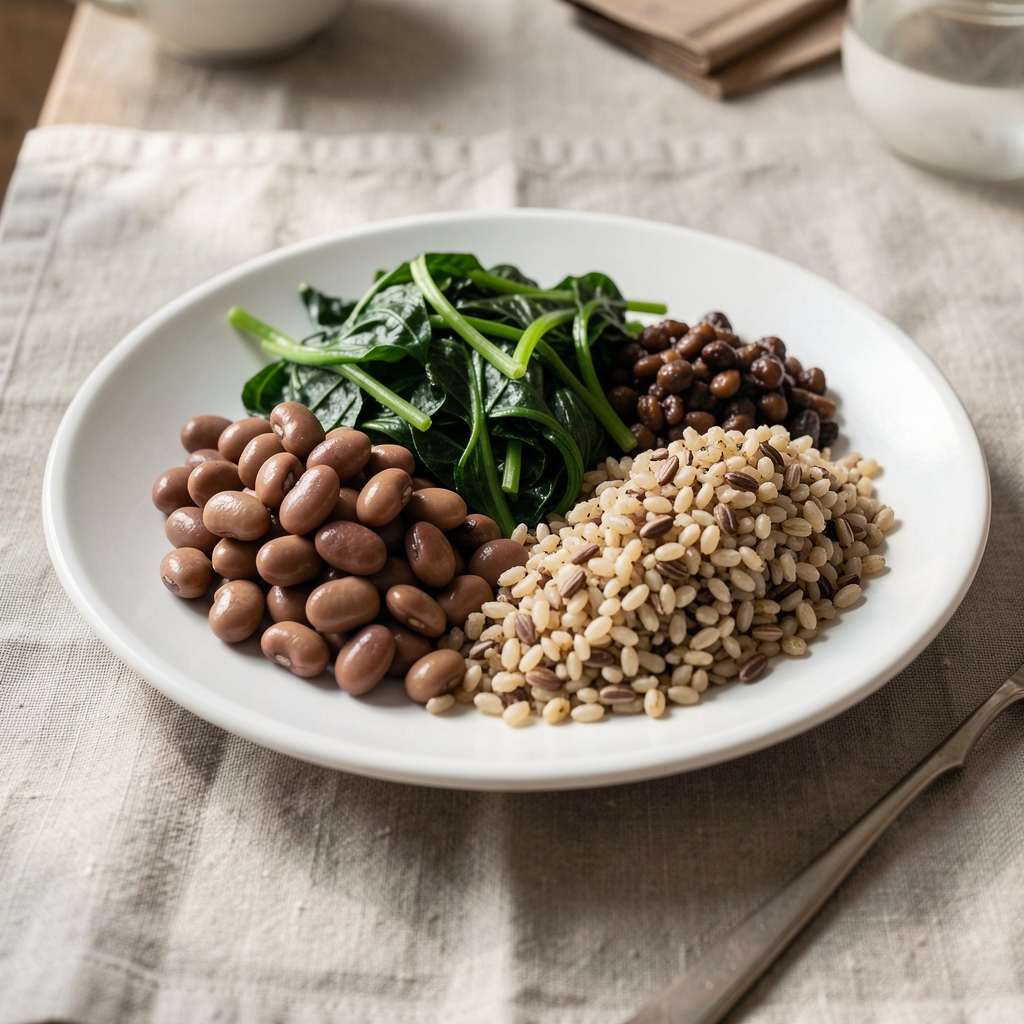
The working afternoon presents a particular challenge to sustained focus: it arrives, reliably, at the moment when the morning's momentum has spent itself and the last commitments of the day are not yet close enough to generate their own pressure. Into this window falls the midday meal and its consequences. Among the food choices available for lunch, the question of which best support a steady post-meal attention span is one the nutritional research addresses with some consistency — and with an answer that centres, repeatedly, on whole grains and protein.
The nutritional distinction between whole grains and refined starches has been documented extensively in the research literature, and its relevance to post-meal energy extends well beyond the afternoon hours. For the purposes of this article, the key distinction is in the rate at which each type of carbohydrate is absorbed: whole grains, with their fibre intact, present a more gradual absorption profile than their refined equivalents.
This slower absorption profile is associated, in multiple published nutritional observations, with a more measured post-meal energy pattern. Where refined starch produces a relatively rapid rise and fall in available glucose — the curve that research connects with post-lunch drowsiness — whole grains tend to support a flatter, more extended energy profile. The effect is not dramatic in any individual meal; it accumulates over the course of a working week, and it is more visible in the pattern than in any single afternoon.
The fibre content of whole grains also plays a role that is less frequently discussed in popular accounts of the lunch-alertness relationship. Fibre-rich foods support a measured post-meal energy pattern by slowing the overall digestive process and moderating the body's glycaemic response. Vegetables at lunch contribute to nutritional variety mid-day in a way that refined carbohydrates cannot. The combination of whole grains and vegetables — a bowl of barley with roasted roots, say, or a lunch of brown rice alongside leafy greens and a protein source — represents the kind of compositional balance that the research tends to favour in post-meal energy observations.

Protein-rich lunches contribute to a steady afternoon energy rhythm in a way that the nutritional research has documented across multiple study populations and food contexts. The proposed mechanisms include protein's relatively slower digestion compared to refined carbohydrate, its role in moderating the glycaemic response of the overall meal, and its influence on satiety — the sense of having eaten — which appears to moderate appetite signals through the working afternoon in a way that can support more settled attention.
The practical sources of protein at a midday meal vary considerably by food preference, cultural context, and what is available. The research does not identify a single source as uniquely favourable for afternoon focus; what it consistently observes is that a midday meal including a meaningful protein component — whether from eggs, fish, legumes, meat, or dairy — tends to be followed by a more sustained post-meal attention period than one without.
This observation holds with particular consistency when the protein source is paired with both fibre and a moderate carbohydrate portion. The combination — often described in nutritional research as a balanced macronutrient profile — appears to produce a post-meal energy pattern that is neither spiked nor dramatically flat, but rather measured: available for sustained work without the marked drowsiness associated with high carbohydrate load meals.
"Protein-rich lunches contribute to a steady afternoon energy rhythm. The combination of whole grains, protein and fibre appears to produce a post-meal energy pattern that is measured and available for sustained work."
A lighter midday meal — in terms of total volume — is associated with a more attentive afternoon in several published nutritional observations, independent of its macronutrient composition. This does not mean that smaller meals are categorically superior for afternoon focus; the evidence on meal size is more nuanced than a simple "less is more" conclusion. What it suggests is that the digestive demand of a very large meal, regardless of its composition, draws on resources that may otherwise be available for sustained cognitive engagement.
Light eating habits — in the sense of meals that satisfy hunger without creating a notable sense of heaviness — appear across the evidence as a consistent feature of patterns associated with more attentive afternoons. The editorial team observed this in its field notes from the autumn of 2025: among the working adults who reported the steadiest post-lunch attention, a recurring description was of meals that were satisfying but not filling in the way that heavier lunches often are — meals that left the body ready for the afternoon rather than engaged in processing a substantial intake.
This is not a universal observation. Some individuals report that a larger, more substantial lunch improves their afternoon if the morning has been particularly demanding or if breakfast was minimal. Individual variation in post-meal response is genuine and significant. The journal notes the pattern without prescribing an amount.
The nutritional research on whole food approaches to midday eating and afternoon mental clarity does not, in most cases, isolate a single compound or mechanism as the active factor. The evidence describes a pattern rather than a pathway: meals built from relatively unprocessed ingredients — whole grains, vegetables, legumes, eggs, fish — tend to produce more stable post-meal energy profiles than meals built predominantly from processed or refined foods, even when the caloric content of the two is similar.
This pattern is consistent with what nutritional research describes more broadly as the benefits of dietary variety — the observation that a wider range of food types at a single meal, or across the day, tends to support more stable energy and attentiveness than a narrow or repetitive intake. For the midday meal specifically, this translates into a practical observation: a lunch that draws from multiple food categories tends to produce a more settled afternoon than one that draws from one.
Whole food energy — the term is descriptive rather than prescriptive — refers to the energy profile that whole, minimally processed foods tend to produce: gradual, extended, and relatively even rather than rapid and short-lived. The research on afternoon alertness consistently favours this profile, not as a rule, but as an observed tendency across varied study populations and eating contexts.
The afternoon food routine — what is eaten at midday, and how it shapes the subsequent hours — is an object of observation that the journal will continue to document across its publications. This article has focused on one aspect of that routine: the role of whole grains and protein in supporting a more stable post-meal energy pattern. The evidence on this point is consistent enough across the research literature to warrant its inclusion in the journal's ongoing record.
What the journal does not do is convert this evidence into a set of instructions. The relationship between food choices and concentration is complex, individual variation is substantial, and the research — while consistent in its general direction — does not support the kind of specific claims that popular food writing often makes. The journal's role is to document the patterns the evidence describes, report what field observation confirms, and leave the conclusions to each reader.
Eating patterns and productivity are connected in the evidence. Food and mental clarity are associated across the research. These are not ensures, and they are not prescriptions. They are observations — and observation, in the journal's view, is where useful understanding of the daily food routine begins.

Harriet Marsden is a food journalist whose work appears in several independent publications. Her contributions to Spilo Journal focus on whole-food approaches to midday eating and their relationship to sustained afternoon focus across different working environments.